

From Pharaoh to ICE
How scripture teaches us to recognize tyranny—and resist it

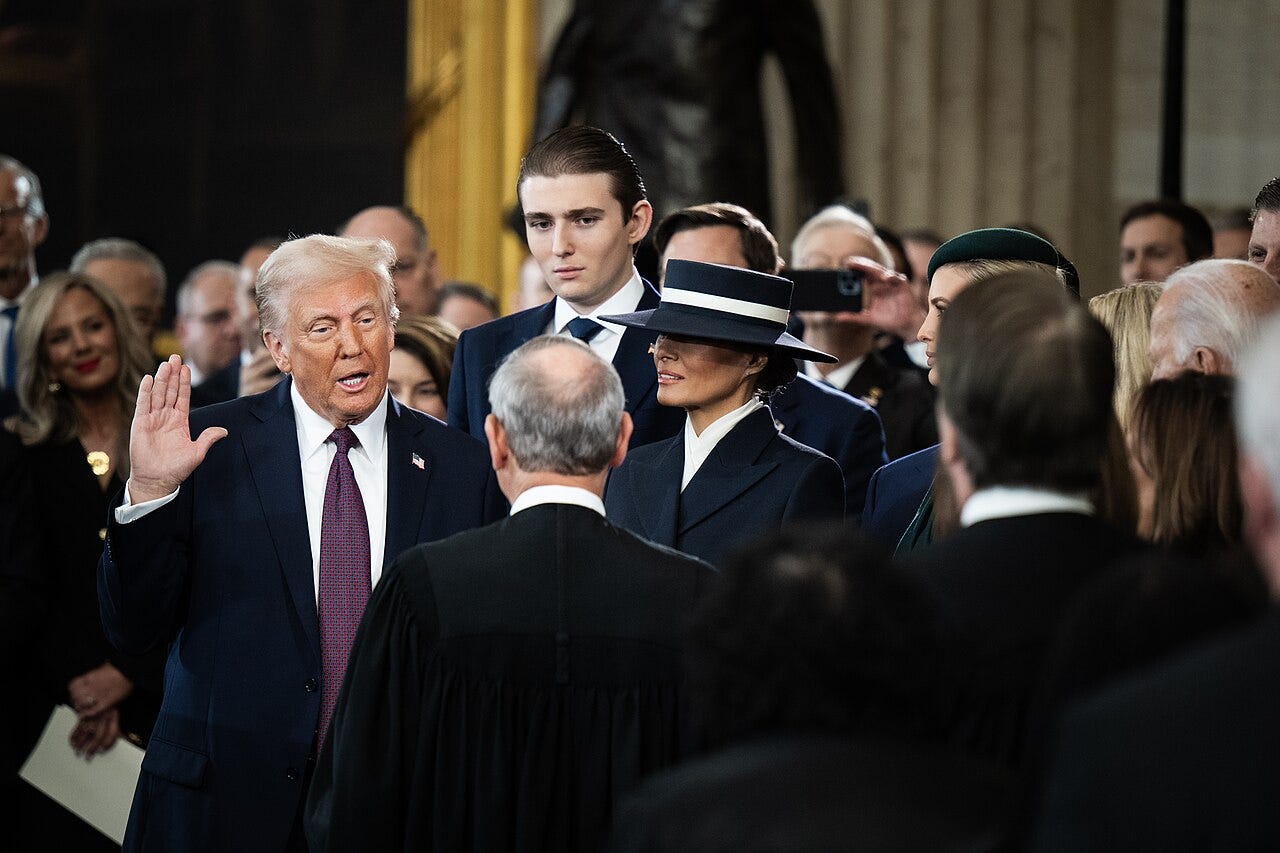
One year ago today, Donald Trump placed his hand on a Bible and swore to preserve, protect, and defend the Constitution. It’s worth pausing to ask: what have we learned in these twelve months?
We’ve learned something Scripture has been teaching for millennia: how to recognize a particular kind of power. Not just flawed leadership or misguided policy, but a pattern that appears across centuries and cultures—rulers whose relationship to power follows a devastatingly consistent blueprint.
The Hebrew prophets knew it. The early Christians knew it. And the biblical writers documented it carefully, not as ancient history but as warning: Learn to recognize this. Know what it looks like. Understand what faithful resistance requires.
The Pattern Across Scripture
When Pharaoh felt threatened by Hebrew population growth, he scapegoated an entire people, forced them into brutal labor, and when that wasn’t enough, ordered the killing of their children (Exodus 1:8-22). The cruelty wasn’t incidental—it was the method of control. Pharaoh claimed divine status, positioning himself as a god deserving absolute obedience.1
When the Assyrian king Tiglath-Pileser III conquered territories, he perfected deportation as state policy, deliberately destroying communities by scattering populations from their homelands (2 Kings 15:29).2 But he also documented his atrocities—skinning captives alive, mass impalement, systematic terror—as psychological warfare. The brutality was meant to be seen, to be feared, to break resistance before it formed.
When Nebuchadnezzar destroyed Jerusalem and forced the exile, he didn’t just conquer—he attempted to erase identity, demanding absolute loyalty to Babylonian power, rewriting the story of who belonged and who didn’t (2 Kings 24-25; Daniel 1-6).
When Antiochus IV declared himself “Epiphanes”—”God Manifest”—he claimed not just political authority but divine status (1 Maccabees 1:41-64; 2 Maccabees 6:1-11).3 He desecrated the temple, demanded worship, and brutally suppressed any who refused to participate in the lie about his own supremacy.
When Nero and Domitian persecuted early Christians, they labeled faithful witnesses as “enemies of the state,” “haters of humanity,” threats to Roman security.4 Truth-tellers became terrorists in the empire’s official narrative. Both emperors claimed divinity and demanded worship as gods.5
The biblical pattern is consistent: These rulers scapegoat the vulnerable. They use terror and spectacle to maintain control. They rewrite reality to serve their power. They claim divine authority or special status that places them above accountability. They demand absolute loyalty. They label witnesses as threats. And they reserve their greatest violence for those who refuse to participate in the lie.
Scripture doesn’t just criticize these rulers. It condemns them and teaches us to recognize the pattern itself.
The Blueprint Unfolds
Throughout 2024, Trump repeatedly disavowed Project 2025, calling it “ridiculous,” insisting it had “nothing to do” with him. Yet according to NPR’s reporting, many of those policies—from dismantling the Department of Education to the immigration crackdown—have been systematically implemented.6 California Attorney General Rob Bonta put it bluntly: “A lot of the policies from Day 1 to the last day and in between that the administration has adopted are right out of Project 2025.”7
The denial was never about the policies. It was about plausible deniability. Tyrants always have a blueprint. And Project 2025 is explicitly a Christian nationalist blueprint—seeking to institute a theocratic state that privileges Christianity in law and policy, dismantling the separation of church and state that protects religious freedom for all.8
Within hours of inauguration, Trump signed over 200 executive actions, including pardons for 1,500 people convicted of crimes from the January 6 insurrection.9 Some have received government compensation for their time in prison.10 The message was unmistakable: violence in service of power earns not punishment but reward. Just as Nero honored those who turned in Christians, just as Antiochus rewarded enforcers of his supremacy, violence that serves the regime is celebrated.
The administration withdrew from 66 international organizations, shut down USAID, gutted the State Department, and slashed foreign aid while pouring $170.7 billion into immigration enforcement—including $45 billion for ICE detention facilities, a 265% increase.11 During the government shutdown, SNAP benefits were cut off, leaving the most vulnerable—including children—to go hungry while ICE agents continued receiving paychecks and overtime.12
Walls over bridges. Isolation over cooperation. The pattern of empire: withdraw from mutual accountability, consolidate unilateral power.
Scapegoating and Exile
For the first time in at least 50 years, the United States experienced negative net migration in 2025.13 The Department of Homeland Security reports over 622,000 deportations, with an additional 1.9 million people voluntarily leaving.14 Hundreds of FBI agents were pulled from counterterrorism and espionage cases to conduct immigration raids.15
The echoes of Assyrian policy are unmistakable. Tiglath-Pileser III didn’t just conquer—he systematically deported populations from their homelands, destroying communities, using forced migration as a tool of control. The cruelty was the point. The terror was the method.
Previous administrations also conducted deportations, but there are crucial differences. The Obama administration’s deportations were primarily at the border, focusing on recent arrivals.16 The Trump administration conducts interior enforcement—workplaces, homes, long-term residents, families who have lived here for decades. The tactics are deliberately terrorizing: militarized raids, separation of families, and crucially, the shooting of witnesses and U.S. citizens who document these operations.17
The Trump administration promised safety from “the worst of the worst” criminals. Yet the numbers tell a different story. About 8% of arrested migrants have been convicted of violent crimes.18 The administration defines anyone who breaks immigration law—a misdemeanor—as a “criminal.” The scapegoating requires expanding the definition of threat until it encompasses entire populations. Like Tiglath-Pileser’s deportations, the administration has detained and even deported U.S. citizens.19
When 37-year-old Renee Nicole Good—a U.S. citizen—was shot and killed by an ICE agent while documenting an immigration operation in Minneapolis, the administration immediately called her and her wife “domestic terrorists.”20 Video evidence contradicted the official narrative, much like it did when ICE shot Chicago teaching assistant Marimar Martinez and initially claimed she had “ambushed” agents before footage proved otherwise.21
This is the Nero playbook: witnesses become enemies of the state. Those who document injustice become terrorists. When witnesses become “terrorists” and victims become “threats,” we are watching the deliberate dismantling of shared reality itself.22 This isn’t just bad policy. It’s the same pattern Orwell warned about, the same pattern Scripture documents across centuries: power that demands we deny what our eyes see, that insists we participate in the lie.
Imperial Conquest
On January 3, 2026, Trump’s first major foreign policy move was to invade Venezuela in the middle of the night, capture President Nicolás Maduro, and bring him to New York for trial.23 Trump then announced the United States would “run” Venezuela, including controlling its oil sales.24
He called it the “Donroe Doctrine”—reimagining American dominance in the Western Hemisphere. The administration is threatening to coerce Denmark’s Greenland into U.S. territory. It has conflated organized crime with terrorism across Latin America, expanding the Foreign Terrorist Organization list from four to nineteen groups.25
When military officials were required to sign NDAs about Latin America operations, when strikes on alleged drug vessels killed over 100 people without accountability, we saw what power looks like untethered from international law.26 This is empire without even the pretense of justice—Nebuchadnezzar declaring that Babylon’s will is the only law that matters.
What Resistance Looked Like Then
When Pharaoh ordered the killing of Hebrew boys, the midwives Shiphrah and Puah refused. They committed civil disobedience—they broke the law—saved lives, and when questioned, they lied to power (Exodus 1:15-21). Scripture honors these two women by naming them.
When Nebuchadnezzar demanded worship of his golden image, Shadrach, Meshach, and Abednego refused, even facing execution (Daniel 3). When Antiochus demanded participation in idolatry, the Maccabees resisted (1 Maccabees 2-7; 2 Maccabees). When Rome demanded worship of the emperor, early Christians refused and died for it.27
The biblical pattern of resistance is equally consistent: Refuse to participate in the lie. Protect the vulnerable, even at personal cost. Tell the truth, even when it’s dangerous. Build networks of mutual aid. And prepare for the long haul—because empires don’t fall quickly, but they do fall.
What Resistance Requires Now
A Quinnipiac poll found 57% of Americans disapprove of how ICE is enforcing immigration laws, a 20-point margin.28 Public opinion is shifting. But opinion alone doesn’t stop deportations or prevent the next militarized raid. It certainly won’t resurrect Renee Good.
The question facing people of faith—and all people of conscience—is whether we will normalize what’s happening or name it. Will we treat this as just another political cycle, or recognize it as the pattern Scripture repeatedly warns us about?
In John’s Gospel, Jesus tells Pilate: “Everyone who belongs to the truth listens to my voice.” Pilate responds with cynicism: “What is truth?” (John 18:37-38). He’s not genuinely asking. He’s dismissing the very possibility that truth can hold power accountable. He represents the empire that will kill Jesus to maintain control, that will later call Christian witnesses “enemies of humanity.”
We’re living in Pilate’s question. We don’t have to accept his answer.
First, we must refuse to become numb. When ICE agents shoot civilians and call them terrorists, when administrations lie about video evidence, when witnesses are prosecuted instead of shooters—outrage is the spiritually-appropriate response. The prophets didn’t maintain polite neutrality in the face of injustice. Neither should we.
Second, we must build networks of mutual aid and resistance. Governor Tim Walz’s call for Minnesotans to document ICE operations shows what state-level resistance can look like.29 Cities and states pushing back on federal overreach matter. So do faith communities offering sanctuary, legal defense funds, and political organizing. The early church survived empire by becoming a network of mutual care that the empire couldn’t fully suppress.
Third, we must prepare for the long haul. This isn’t a one-year problem. The Project 2025 blueprint extends beyond immigration to education, healthcare, climate policy, and civil rights. Axios reports dozens more action items awaiting implementation in 2026.30 We need sustained organizing, not just reactive outrage. Daniel served in Babylon for seventy years. The early church survived three centuries of intermittent persecution. Faithfulness is measured in decades, not news cycles.
Finally, we must tell the truth, even when—especially when—it’s costly. Renee Good died bearing witness. Six federal prosecutors resigned rather than investigate her instead of her killer. A UAW worker shouted “pedophile protector” at Trump in Michigan and was suspended from his job.31 Truth-telling has consequences. But so does silence.
Dietrich Bonhoeffer, writing from a Nazi prison, warned against cheap grace that offers forgiveness without repentance, reconciliation without truth-telling.32 He understood what it cost to tell the truth under tyranny—and he paid that cost with his life. The prophets knew that silence in the face of systemic injustice is complicity with it. Jeremiah couldn’t stay silent even when it meant prison (Jeremiah 37-38). Amos couldn’t stay silent even when the king told him to leave (Amos 7:10-17). The early Christians couldn’t stay silent even when it meant the lions.
Archbishop Desmond Tutu—one of my seminary teachers—said it plainly: “There can be no real peace without justice.”33 Both Tutu and Bonhoeffer understood what Scripture teaches: faithfulness sometimes requires taking costly stands against rulers who follow this ancient, terrible pattern.
One year in, we know what we’re facing. Scripture has given us the pattern to recognize it. History has shown us how people of faith have resisted it. The question is whether we have the courage to do the same.
The biblical witness testifies: God stands with the vulnerable against Pharaoh’s cruelty, with the exiled against Nebuchadnezzar’s empire, with the faithful against Antiochus’s demands for worship, with the witnesses against Rome’s labels of terrorism.
The pattern Scripture teaches us to recognize also teaches us where we must stand and how to resist without becoming what we oppose.
In ancient Egyptian theology, Pharaoh was considered the living embodiment of the god Horus and the son of Ra, the sun god. See Jan Assmann, The Mind of Egypt: History and Meaning in the Time of the Pharaohs (Cambridge: Harvard University Press, 2003), 204-210.
See also the Assyrian records documenting Tiglath-Pileser III's deportation policies in Daniel David Luckenbill, Ancient Records of Assyria and Babylonia, Vol. 1 (Chicago: University of Chicago Press, 1926), 293-294. Tiglath-Pileser III reigned 745-727 BCE. The book of Jonah, likely written centuries later during the Greek period, invokes Nineveh and its king as Israel's collective memory of Assyrian imperial brutality—making God's concern for even this epitome of violent empire all the more theologically provocative.
"Epiphanes" means "God Manifest" or "God Made Visible."
Tacitus, Annals 15.44, describes Nero's persecution of Christians, calling them "haters of humanity" (odio humani generis).
The imperial cult required worship of the emperor as divine. See S.R.F. Price, Rituals and Power: The Roman Imperial Cult in Asia Minor (Cambridge: Cambridge University Press, 1984); Revelation 13:4, 15 describes this demand for worship.
NPR, "Trump has rolled out many of the Project 2025 policies he once claimed ignorance about," January 19, 2026.
Ibid.
See Project 2025, Mandate for Leadership: The Conservative Promise (Heritage Foundation, 2023), particularly chapters on education, health and human services, and the Department of Justice, which explicitly advocate for privileging Christianity in public policy and rolling back church-state separation.
ABC News, "1 year into Trump's 2nd term, here are some of the seismic shifts in foreign and domestic policies," January 20, 2026.
Heather Cox Richardson, "Letters from an American," January 13, 2026.
Chicago Council on Global Affairs, "Trump 2.0 Enters 2026 in Full Force," January 7, 2026; Heather Cox Richardson, "Letters from an American," July 2, 2025.
Heather Cox Richardson, "Letters from an American," October 28, 2025; Sasha Rogelberg, Fortune, October 2025.
ABC News, January 20, 2026.
Wikipedia, "Second presidency of Donald Trump."
Heather Cox Richardson, "Letters from an American," April-June 2025.
See U.S. Department of Homeland Security reports showing that under Obama, approximately 90% of deportations were of individuals apprehended at or near the border. Migration Policy Institute, "The Obama Record on Deportations: Deporter in Chief or Not?" January 2017.
Illinois Governor J.B. Pritzker filed suit against the Trump administration for "dangerous enforcement tactics and unlawful use of force." See Illinois Governor's Office press release, January 13, 2026.
Heather Cox Richardson, "Letters from an American," July 2, 2025.
AP News reported cases of U.S. citizens being detained during ICE operations; The New York Times documented cases where citizens were held for days or weeks before their citizenship could be verified.
Heather Cox Richardson, "Letters from an American," January 13, 2026; AP News, "Minneapolis ICE shooting leaves woman dead," January 13, 2026.
Heather Cox Richardson, "Letters from an American," January 13, 2026.
See also my previous essay: "Before Room 101: Choosing Truth While We Still Can," Grace and Truth, January 2026.
Chicago Council on Global Affairs, January 7, 2026.
ABC News, January 20, 2026.
WOLA, "Trump Administration's Aim to Dominate Latin America: A Year In Review," January 15, 2026.
Heather Cox Richardson, "Letters from an American," October 2025; ABC News, January 20, 2026.
Pliny the Younger's letter to Emperor Trajan (c. 112 CE) describes executing Christians who refused to worship the emperor; see Pliny, Epistles 10.96-97.
ABC News, January 20, 2026; Heather Cox Richardson, "Letters from an American," January 13, 2026.
Minnesota Governor Tim Walz, public statement, January 14, 2026.
Axios, "Trump's first year reflected many Project 2025 goals. Here are some that remain," January 1, 2026.
Heather Cox Richardson, “Letters from an American,” January 13, 2026; Natalie Allison and Dan Merica, The Washington Post, January 2026.
Dietrich Bonhoeffer, The Cost of Discipleship (New York: Touchstone, 1995 [1937]), 45.
Desmond Tutu, No Future Without Forgiveness (New York: Doubleday, 1999), 54-55.
Facinating use of Pliny's correspondence with Trajan as historical precedent. That letter shows how bureaucratic persecution works, where local officials ask for "proper procedure" when dealing with dissenters. I've noticed similar pattern recognition in modern contexts, the administrative distance from violence makes it feel legitimate til you actualy step back.